
table of contents
questions?

Reach out directly.
We will get back to you
right away.

Introduction

Direct selling is the essence of free enterprise. Thousands of direct selling companies have sprouted during the last few decades. Sadly, many are no longer in business. I have been entrenched in the direct selling industry for over twenty five years and have seen hundreds of companies come and go. As the years have passed, By reading a few tips on https://shibga.com/ I have discovered patterns of success and tragic mistakes that weaken direct selling businesses often to the point of failure. While there are many reasons for failure, it is my hope that by understanding ten of the more common mistakes, an aspiring direct selling business owner might have a better chance at success than those that failed to see the picture clearly. These ten common mistakes include:

1. Inadequate planning
2. The wrong business model
3. Poorly designed compensation plan
4. Lack of a good field training system
5. Lack of an effective selling system
6. Inexperienced management team
7. Computer software that doesn’t work
8. Listening to the wrong people
9. Poor customer service
10. Growing too fast

While these mistakes are not in any particular order, they carry with them differing levels of severity if committed. For example, while a poorly designed compensation plan can become a major obstacle to the success of the organization, it isn’t too difficult to correct the problem by changing to a good one. Lack of funding, however, can quickly force a company out of business within a few weeks when they fail to meet payroll or their commission obligations. Both problems can be fatal, but one is easier to correct than the other. Let’s review these problems in more detail.

#1: Inadequate Planning

The world of direct selling has a variety of business models. The model you choose will determine the type of compensation strategy you employ, how you sell your product, and how you grow the business. For example, Avon’s business model relies mostly on retail sellers using catalogs to sell their products to customers. Melaleuca and Arbonne, instead, have thousands of customers who signed up as distributors to buy their products at a substantial discount off retail. They have few people buying their products at the full retail price. Pampered Chef and Tupperware rely extensively on the home party to demonstrate their products to customers.

Let’s suppose you want to build a house and have borrowed $350,000 to complete the project – the most your bank will lend you. You have $50,000 of your own money to add to the mortgage and expect the house to cost no more than $400,000. During the construction, you found a few unforeseen problems. While digging the basement, a water spring was found that had to be routed to a different part of the property. Cost: $8,000. Lumber prices rose 30% from the time you started the project. Cost: $12,000. You upgraded the carpeting hoping to make up the difference in other areas. Cost: $9,000. As you near the end of the project, try as hard as you might, you can’t get the house complete without another $40,000. You’ve already borrowed as much as you can to get the $350,000. You have no more money of your own. What will you do?

So it is with starting a business. Many well intentioned entrepreneurs embark on a long journey to prosperity full of hopes and dreams. As they journey along the road, they hit a few “water springs”, and find many things costing far more than expected. They make a few mistakes which are expensive to fix, and soon find they didn’t budget enough money to get the business off the ground. These people always come away from the experience learning a golden rule of business: Know how much money you need beforehand and secure the funds before you start.

How does a person find enough capital to start a direct selling business, and how much does he need? Finding the necessary funding will take a well-prepared business plan which is not only reviewed by potential investors and financial institutions, but will also determine the amount of financing needed. No investor will be willing to risk their money without a plan. You shouldn’t either!

Common sources for funding include:

  • Home Equity financing through banks, savings and loans, etc. You can find a wide range of resources on Money Marvel.
  • Venture capital organizations that specialize in helping new businesses. This type of investor or investor group will expect a significant ownership position to take the risk. Venture capital groups are found by networking with financial planners, accountants, bankers, and merger/acquisition specialists. You may find a few that know the direct selling industry by going to www.dsa.org and looking through the supplier members list (search for “Finance”). Be prepared to give up a healthy chunk of your equity if you ask them to take on a big part of the risk.
  • Private or ‘angel’ investors, including friends, business associates, friends of friends, etc. Find them by networking with everyone you know. Talk to financial planners, accountants, business owners, etc.
  • Small Business Administration or other federal and state agencies. These agencies will either loan the money or guarantee a loan through a bank. In either case, you’ll need to be able to pay back the loan on a set schedule. See www.sba.gov for more information.
  • Local community bond funding. Some communities, especially those with high unemployment, work aggressively with businesses to acquire funding for starting or expanding, especially in areas of high unemployment. Contact local county and state agencies to see if programs are available in your area.
  • General bank financing. Banks will often lend based on credit history and assets, with a personal guarantee of the business owner or another creditworthy third party.
  • Don’t become impatient and launch the business without the necessary funding! How much funding is necessary will depend on your business plan. Some companies start for as little as $50,000, while others find they require several million dollars. Your business plan will tell you how much you need.

Lack of an effective Business Plan

A business plan is the “first creation” of a business, just as an architect’s blueprint is the first creation of a beautiful home. A good architect will plan out every detail of a home long before the first shovel of earth is moved. So it must be with any business. You must become a business architect before you can build the business. Companies that are successful without a plan gain their success more by accident and luck than by design and thought.

A key benefit of the business plan is that it is often used to attract potential investors, lenders, and vendors. No investor will be willing to risk their capital on a business venture without a well- designed business plan. You shouldn’t either!

Investors have plenty of other candidates to consider who have prepared a compelling business plan. You compete with those other candidates, so consider your business plan much like a resume – you want to give them a compelling reason to pick you rather than the others they are considering.
As you establish credit with vendors, they will be more willing to grant credit if they can review a well-prepared business plan. Remember that any credit granted by vendors reduces your starting capital requirements; if your manufacturer is willing to extend 90-day terms for $100,000 of product, you will need $100,000 less to start.

A business plan should include:

  • An Overview: One or two pages describing the business will help a potential investor become interested in learning
    more of the opportunity. If an overview is missing, few investors will be interested enough to take the time to read the entire plan. The overview should describe the products or services being sold, the principals involved, funds required to launch, and estimated return on investment, both conservative and potential. It should also include an exit strategy for initial investors.
  • Background of Management Team: A summary resume of the owners and executives of the company is a critical part of a business plan that will be read by investors, banks, and other trade creditors. A common expression among investors is ‘bet on the jockey, not on the horse’. In other words, the strength of the management team is often considered as being more important than the company, product, or compensation plan being offered.
  • A mission statement that clearly identifies what the company is all about should be included. It’s been said that distributors will work for money, but kill for a cause. Your mission statement should be something you can proudly display in literature or on a wall plaque. A corporate motto might be taken from the mission statement. Most mission statements are expressed in one or two paragraphs. Find samples of mission statements in annual stockholder reports of many public companies. There are a number of books available that also teach how to write and use a mission statement.
  • A product description section describes your products and what makes them unique. Case in point, a product from dehumidifiercritic.com – by Oliver J. Perryman has been described accurately. This is called your ‘Unique Selling Proposition’ or “USP”.
  • Goals and objectives should be identified and each should spring from the mission statement. Goals might reflect the level of customer satisfaction, order turnaround, staff efficiency, but most certainly sales and profits.
  • A market analysis must be done to determine the potential of the product or service, priced as it is to be priced (based on end user pricing rather than wholesale pricing to your sales force). The analysis should address market demand, similar products and how they have been accepted and marketed, competition, etc. This information might be found on the Internet, in libraries, universities, and other business consulting groups. The Small Business Administration has access to large amounts of information and people who can get the information for you. Many universities have business students who would love to do market research for businesses, often at no charge, for their MBA requirements.
  • Your recruiting & marketing plan explains how you will build your sales force and promote your products, you can search for guidance with professionals to learn or to let them do the work for you. We do recommend the smt digital agency By far a great lead generation agency specializing in HVAC Leads. What sales support materials are required? Who is your target audience? How will you reach them? This is not your compensation plan.
  • Operational plans: How much office space will you need? How many employees will be needed to handle the expected business volumes? Warehouse space, telephone equipment, initial product orders, printing, distributor kits, videos, and scores of other issues must be addressed in as much detail as possible. This section may be the most important section of all and is usually the one people try to gloss over. It’s more fun to make sales projections than to figure out how much office space is needed. Yet, one major mistake in this area can cost tens (or hundreds) of thousands of dollars. This part of the plan takes time, often several months. Time spent here will pay huge dividends in the future.
  • Projections: Profit/Loss and cash flow projections are critical to every business plan. A competent consultant or accountant can assist in this effort by identifying common areas of expenses for new start-up businesses. With computer spreadsheet programs like Microsoft Excel, many different scenarios can be created once an initial spreadsheet format is built. Always prepare a pessimistic “worst case” scenario, a middle of the road scenario, and an optimistic (but realistic) best case version. As you develop your business plan, always plan on the conservative side, but be ready to scale up into the more optimistic version should the need arise. Remember that if your investor has read the overview, the next thing he’ll want to know is how much money is needed. These projections are critical to a prospective investor.
  • Return on Investment Analysis is important for those investing into the business. This is why they would want to take the risk. Attractive charts and graphs are essential. This section answers the investor’s question of what’s in it for me? Remember that you are competing for their money against other options they will evaluate like yours. Investors are quickly turned off by hype so be conservative in your estimates.
  • Risk Analysis: Careful study of the each known risk and the assumptions involved should be explained in this section. While not intended to “turn off” a potential investor, most investors will do their own risk analysis but with only the bits and pieces of information available. This is an opportunity for you to address the potential concerns of an investor in a positive and controlled fashion. If you don’t need an investor, this section will make your business plan more bulletproof. No plan is viable that hasn’t addressed the potential points of failure and risk. If an investor finds that you have overlooked some key areas of risk, they will assume you are headed for failure.

Once the plan is complete, bind it so it can make an attractive presentation. Do not include your proposed compensation plan as it would only confuse the reader in most cases. Include a table of contents, index tabs, and an impressive cover. Don’t put the plan on the shelf! Use it in each manager’s meeting, refer to it like the corporate bible. Change it when needed, but follow it carefully.

Profitability

Part of the business plan, of course, is to plan to be a profitable company. It’s amazing how many companies fail to plan to be profitable. Here’s a general breakdown of
how income is used in direct selling companies:

  • 40% of income for commissions to the field
  • 20% of income for cost of goods or products
  • 20% of income for administrative expense such as payroll, facilities, utilities, etc.
  • 20% of income for profit

While the above numbers are very rough, they have proven to be a target that many successful companies have set. Your numbers may vary considerably from these. The profit you make on each sale will be a primary factor in determining how much you should allocate to each major category, especially commissions (discussed later).
your ideal recruitment agency

view related content

  • Binary Compensation Plans: The Good, the Bad, and the Ugly

    Binary Compensation Plans: The Good, the Bad, and the Ugly

    by Dan Jensen, Compensation Plan Specialist

    Binary compensation plans were invented in the 1980’s and, over time, gained some notoriety for fast growth leading to periods of popularity in the global Direct Selling / MLM Industry. They have several unique characteristics that set them apart from most other types of compensation plans.

    How Binary Plans Work

    Lineage

    • A distributor has only a “left leg” and “right leg” in their binary lineage structure.
    • The leg with the least amount of volume is considered the “Weak Leg” or “Pay Leg”
    • When a person already has both the left and right legs started, any additional recruits they enroll are placed by the computer in one of the two legs chosen by the sponsor. This is called “placement” and “spillover”.
      • Each company maintains a policy for how the computer decides the next available position for a new recruit which is most commonly the outermost available position like the outside edges of a Christmas tree. Sponsors are often not allowed to choose the exact location their new recruit is placed but they are allowed to choose which leg, right or left. Some binary plans do allow specific “inside leg placement” where the sponsor chooses the precise location where a new recruit is placed. This practice is not recommended as it leads to considerably higher payout cost for the plan and very high levels of plan manipulation by the field.
      • The sales pitch often used is that an individual may have one leg built for them through this spillover from their upline while they must build the other leg themselves. However, this is seldom the reality.
      • Leaders learn quickly the strategies of building their binary downline structures, always focusing their efforts on adding more recruits into their weakest leg while trying to balance the two legs (which is nearly impossible to achieve for leaders).
    • Many Binary plans do not use the Binary Lineage for team structure requirements in their Career Path (title) requirements. Instead, the Enrollment Lineage is used for some of the title requirements instead. We recommend not using the Binary Lineage for any Career Path requirements including volume and team structure to avoid rampant manipulation and disproportionate results for different builders.

    Payout

    • Most binary plans pay weekly
    • Binary Commissions are most often a percentage (often 10%) paid on the volume from the Pay Leg (weakest volume leg), infinitely deep.
    • Some binary plans pay a fixed bonus amount for one or more volume levels in the Pay Leg (Usana). For example, a binary payout may pay $50 per block of $500 in volume in the Pay Leg. Any volume that does not complete a block of $500 is carried forward to the following week(s) until the next block has been accumulated.
    • When a commission is paid, the amount of paid volume is deducted from both the Pay Leg and the Strong Leg. The Pay Leg volume starts the next commission cycle (week) at zero while the Strong Leg starts the next cycle at a reduced amount using the rules of Carry Over Volume (see above).
      • Example: if a Pay Leg has $500 in volume and a Strong Leg has $2,000 in volume, the Binary payment is paid on the $500 Pay Leg volume. The Pay Leg volume is reset to zero and a matching $500 in volume is removed from the Strong Leg, even though no additional payment is made on that volume.
    • A minimum “cycle point” is defined where volume in the Pay Leg must reach a minimum threshold before any binary commission is paid to the recipient. If volume in the Pay Leg is below this cycle point, no binary commission is paid until a future commission period (week) when the minimum cycle point is finally achieved. In most plans, that unpaid volume may carry forward (see “Carry Over Volume” below) until the minimum cycle has been achieved in the future.
      • Breakage (unpaid commissions) is high from reps that never (or rarely) achieve the minimum cycle volume amount. This breakage is vital to keeping the comp plan payout affordable to the company (see Traps to Avoid below).
    • All binary plans have “Carry Over Volume” where unpaid volume is carried forward in both legs to the following week as long as the rep remains “active.”
      • Unused volume in the Strong Leg is carried over to the following commission period. This unused Carry Over Volume is often seen as a compelling reason for a distributor to stay active in the business with the hope they will eventually be paid on the unused volume of their Strong Leg in a future commission period. This can only happen if they successfully develop their Pay Leg into their Strong Leg some day – a very rare event. In such a situation, the former Strong Leg becomes their Pay Leg and they earn a “windfall” amount on the stored Carry Over Volume from that leg. The hope that their unpaid Strong Leg volume will someday become their weak leg is seen as a reason many continue to work and stay in the business for a while longer.
    • If the distributor is Inactive during a commission period (usually because they fail to meet a minimum Personal Volume threshold), the volume in both the Pay Leg and the Strong Leg is “flushed” – reset to zero. For many, the fear of loss becomes a strong motivator to stay Active. Some binary companies use this flushing rule as an added incentive to stay on a monthly AutoShip.
    • Because it is impossible to project the cost of a Binary payout, a payout cap is required to protect the company (see point 4 under Disadvantages to Company).

    What does the Binary Plan Reward Me for Doing?

    When a builder recruits another person, the “pitch” is often focused on encouraging them to build one leg assuming that the new recruit will receive many recruits through Spillover from the upline into their Strong Leg. “If you join under me, you build one leg and I (and my upline) will build your other leg”. As a result, recruiting is the primary behavior the Binary Plan rewards. Some might suggest it is a “recruiting machine”. Your results may vary…

    Advantages to Company

    1. Some Binary Plans find strong recruiting results as builders work to balance their left and right legs, focusing almost entirely on their weak leg.
    2. Some suggest the Binary Plan is a simpler plan to explain and work because it only has two legs to focus on. My experience does not support this due to the many other complications the rep must understand such as placement, Enrollment Lineage, Binary Placement Lineage, Spillover, Carry Over Volume, and Flushing.
    3. A Binary Plan seems to work best when the primary strategic focus is on recruiting reps into the business rather than enrolling customers. It supports a “buying club” culture where anyone who wishes to use the product enrolls as a distributor.
    4. Binary Plans tend to highly favor and promote the use of AutoShip to ensure the regular purchase of products.

    Disadvantages to Company

    1. A heavy recruiting emphasis for some can feel too much like an “MLM” and is easily perceived with skepticism. A recruiting culture is often driven mostly by the opportunity and less by the unique benefits of the product and company mission. This rarely creates strong loyalty in the field.
    2. Customer enrollment is often very weak as the sales force focuses on recruiting people into the business (opportunity emphasis over product) like a buying club. Customers cannot take a position in the binary lineage because they are not independent contractors. If they are given a spot in a lineage, regulators usually consider them as reps. As a result, in a binary plan, customers are usually recruited as reps, creating a buying club culture.
    3. Legal challenges in some countries have proven to be more common due to the lack of customer enrollment and heavy emphasis on recruiting. In the United States, attorneys are advising their clients that a minimum of 51% of company revenue must come from known customers who are not distributors. Otherwise, the company may be vulnerable to legal challenge as they grow. A binary plan might make this goal much more difficult to achieve.
    4. Most countries in Asia allow Binary Plans with the exception of Malaysia and some states in India. There may be others we are not aware of.
    5. Due to the infinite depth of pay on the Pay Leg of each distributor, it is impossible to project the cost of a Binary Payout, resulting in a history of Binary Plans paying out too “hot” – paying out more than originally designed as the sales force matures and downline depth increases overall – unless the company utilizes a payout cap, limiting what will actually be paid. When a cap is used, if the Binary payout exceeds the cap, then payouts are reduced to remain within the specified cap.
      • This problem often manifests itself only after several years of strong growth. Many binary plans eventually require reducing the Commissionable Volume (CV) (or Bonus Volume / BV) ratio to the rep price in order to reduce the payout to affordable levels or reduce the amount of reduction occurring due to the cap being exceeded. Some plans reduce only the binary payout or only a check match payout when the cap is applied.
    6. The premise behind the Binary Plan is often based on the assumption that “my Strong Leg will be built by my upline through the Spillover from their recruiting”. However, this assumption often proves to be wrong or even deceptive – most people (more than two-thirds in our research) receive little or no spillover from their upline and have to build volume in both legs while only being paid on the volume in one leg. As a result, two people producing the same volume and number of recruits can have very different outcomes in the Binary Plan depending on where they are placed in the lineage. One may receive lots of spillover (recruits who create volume) from their upline building their Strong Leg without any effort of their own. Their entire focus is solely on building their Pay Leg. For another person who receives no Spillover from their upline, they must build BOTH legs – at least two or three times the work to get the same earnings as the first person. Thus, the actual outcomes for people prove to be less predictable and often disappointing based on the excitement felt when they joined. This causes many to leave the business disappointed.
    7. Growth for all Direct Selling companies can be no greater than the growth of leaders the company develops over time. The more leaders a company develops, the faster they grow. In a Binary Plan, everybody has two legs. They receive no commission from their Strong Leg. But where are most of the potential leaders in their downline? Always in their Strong Leg – that’s what makes it a STRONG LEG! As a result, builders are not rewarded through binary payout for developing leaders who are in their Strong Leg. This results in fewer leaders developing and higher failure rates for existing leaders.
      • For this reason, most binary plans have a “check match” payout technique that compensates somewhat for this big weakness. The check match payout often rewards them for leaders in both their Strong Leg and their Pay Leg by paying a percentage of the binary earnings of downline people (usually leaders) in both legs.
    8. Retention rates of binary plans have generally proven to be the lowest in the industry. Industry averages for all flavors of direct selling comp plans are considered to hover around 20% over a 12 month time period for recruits. Binary plans rarely exceed 10%. While growth can be significant for a short period of time, once the company peaks and sales begin to decline, the momentum often collapses, and leaders leave quickly. As a result of collapse, companies with binary plans appear to have the highest fatality rate for startup MLM companies.
    9. A series of upline sponsors doing little can benefit greatly from the efforts of one or two superstars in their Pay Leg because they receive infinite depth on the same leg. They, of course, love this. For them, the binary system may become an entitlement system. The company, unfortunately, pays out very large amounts to undeserving people at the expense of others who are more deserving. The saying “what one man receives without working, another works for without receiving” is very applicable here.
    10. When a recruit is placed in a binary lineage structure, it is inevitable that some will have distributors under them in a binary plan due to Spillover. Most binary plans act like buying clubs where both business minded builders join to earn money and customers join as reps to buy at a discount. Most recruits are actually customers (“custo-reps”). Legally, this may invite regulatory challenges in some countries because a customer does not recruit and receives no commission but placing them in the lineage makes it appear that they do. Herbalife, for example, claimed to the FTC that their thousands of “members” were only customers because they did not recruit anyone. The FTC rejected this argument because the customer-members were in the lineage structure and had the opportunity to earn money.
    11. A binary plan creates a system of “shared benefits” where some will benefit from the efforts of others with little or no engagement – an upline recruiter may build your strong leg through spillover. Crucial to this discussion, however, is the disconnect between reward and performance and luck. Sustainable comp plans are based on key principles such as “do this, get that… don’t do this and don’t get that”. “Shared Benefits” appears to weaken this vital principle rewarding some lucky few for doing little or nothing while requiring others to work hard and do it all by themselves to get the same reward. Those who do less get the same reward as those who do much more, creating an unpredictable (and unsustainable) business model and a lower level of competency in the field. Do NOT reward people who do little or nothing. You cannot grow your business on the backs of incompetent people. This concept of “Shared Benefits” appears attractive on the surface but it can be very problematic for the company over time creating an entitlement culture (I deserve it). It can be a “ticking time bomb”.
    12. Another concern is the lack of impact on the earnings of a leader who disengages from the business. The binary payout is based purely on volume – usually not current rank or performance. Thus, a 5-Star-Leader who is paid as a 3-Star-Leader because they fail their downline leader structure requirements will likely see little, if any, drop in their binary income. This will create a serious problem in the future with poor leader engagement levels. Leaders whose incomes continue despite their lower level of performance will eventually perform at lower levels. We see this problem everywhere in our industry. This will create a decline in corporate revenue which will be very difficult to turn around. How can you ignite growth without leaders who are willing to re-engage and work harder when they don’t have to?
    13. Binary plans have been outlawed in several countries.

    Advantages to the Distributor

    1. The infinite depth payout promotes tap rooting in the Pay Leg – the reaching down to develop rising stars in that leg. This is excellent but is limited to the Pay Leg.
      • Most Binary Plans use other strategies to reward the development of other leaders, even those in your Strong Leg, such as through a Check Match.
    2. Its greatest strength is the motivational reward for recruiting people into your weak leg. The Binary payout mechanism is a powerful recruiting tool.

    Disadvantanges to the Distributor

    1. Every binary plan has a minimum “cycle point” where a minimum amount of volume in the Pay Leg (weak leg) is required to get ANY commission. The percentage of new recruits in their first 90 days who get to the minimum cycle point is historically very small. Until they achieve the minimum cycle point, they do not receive any binary commission. As a result, we see a consistent pattern of very low retention rates of new recruits for binary plans worldwide – lower than industry averages by far. In a world of instant gratification, most new reps do not have the patience to wait for their binary volume to get to the minimum cycle point. They bail quickly.
      • We could argue that an easy solution would be to not have a minimum cycle point but that would result in the Binary plan paying much too high. The breakage caused by the minimum cycle point is essential to keeping the binary plan payout within budgetary limits.
    2. Rarely will a rep have perfect volume balance between their left and right legs (unless manipulation is occurring).  Some reps get lots of Spillover and build only their Pay Leg thereby receiving binary compensation sooner. Others must build BOTH legs but get paid only on their Pay Leg. Thus, the rep who builds both legs often has developed 3 times the volume of another rep who built only their Pay Leg (due to this natural imbalance between legs). How can anyone consider a plan “fair” when it pays the same reward to a person who worked three times harder than another?

    Common Traps to Avoid

    Most binary plans will eventually pay out more than the company can afford usually due to increasing depth and the amount of placement manipulation occurring. As an example, if a company could pay out 35% of volume from their binary plan, for every order placed the company could pay an average of 3.5 upline sponsors their 10%. In the early growth years, the company may find a low payout of the binary plan while the lineage was shallow to the company and most leaders. But over time, as leader organizations grow deeper, the average number of people paid on any individual order may grow from 3.0 upline sponsors to more than 5.0 upline people (paying out 50%).

    In some cases, the company collapses because they avoid the inevitable fixes required to keep the plan within budget. Various sources of breakage must be designed into the plan to keep the plan from paying out too hot. These sources of breakage include:

    1. Minimum cycle point: A rep must achieve a minimum amount of volume in their Pay Leg before any binary commission is received. Common cycle points range from $300 to $700 (USD). The lower the cycle point the less breakage the plan creates causing it to pay out more. Too high of a cycle point causes reps to realize that they have to wait too long before they earn any commission so they leave the business.
    2. Spillover placement must be limited to the “Outside Leg”. Think of the edges of a Christmas Tree – the edges are the Outside Leg. If the exact location a new recruit is placed in is allowed to be chosen by the Sponsor (I’ll place Linda under Sarah), rampant gaming occurs with builders placing new recruits in just the right places needed to keep their legs balanced and reward specific downline friends and family members, significantly reducing the breakage necessary to keep a binary plan affordable. The affordability of a Binary relies heavily on the field’s inability to balance their legs.
    3. Company capped payout: Almost all binary plans have a declared “cap” that limits how much the company will pay out. Common caps are 50% of CV (or BV). Binary plans vary in how these caps are implemented. Some limit the cap only to the binary payout while others first reduce other payout mechanisms such as check match payouts before a binary payout is reduced. Caps must be disclosed to the field and are often looked down upon for obvious reasons – but they are necessary to keep the plan affordable when the business grows large.

    Conclusion

    Binary Plans are very popular in Asia. Leaders often gravitate to comp plans they can manipulate or “maximize” their income. This manipulation is rampant in Asian markets and eastern European markets. Yet, Binary Plans can create significant growth for many months and in rare cases, even years. A well-designed Binary Plan must consider both its strengths and its weaknesses. Failure to anticipate the weaknesses can result in a collapse of the business. When designed well and with proper policies to avoid manipulation, a Binary Plan can provide sustainable growth as other compensation plans.

  • Roll Up and Compression – To Do or Not To Do…

    Compression. Of all the techniques used to fine tune a MLM compensation plan, compression is one which is most often used, but seldom understood. For many MLM and Direct Sales companies, compression is a source of massive waste in their compensation plan – dollars being spent with little return. For others, it is a source of focused and well planned incentives on distributor performance which is otherwise difficult to obtain.

    Roll Up and Compression – what are they really?

    Compression and Roll Up are terms often used interchangeably in network marketing. Compression can be defined as:

    The impact on a genealogy when a distributor is terminated. The downline of the terminated distributor is linked to the sponsor of the terminated distributor causing a “compression” effect on the downline.

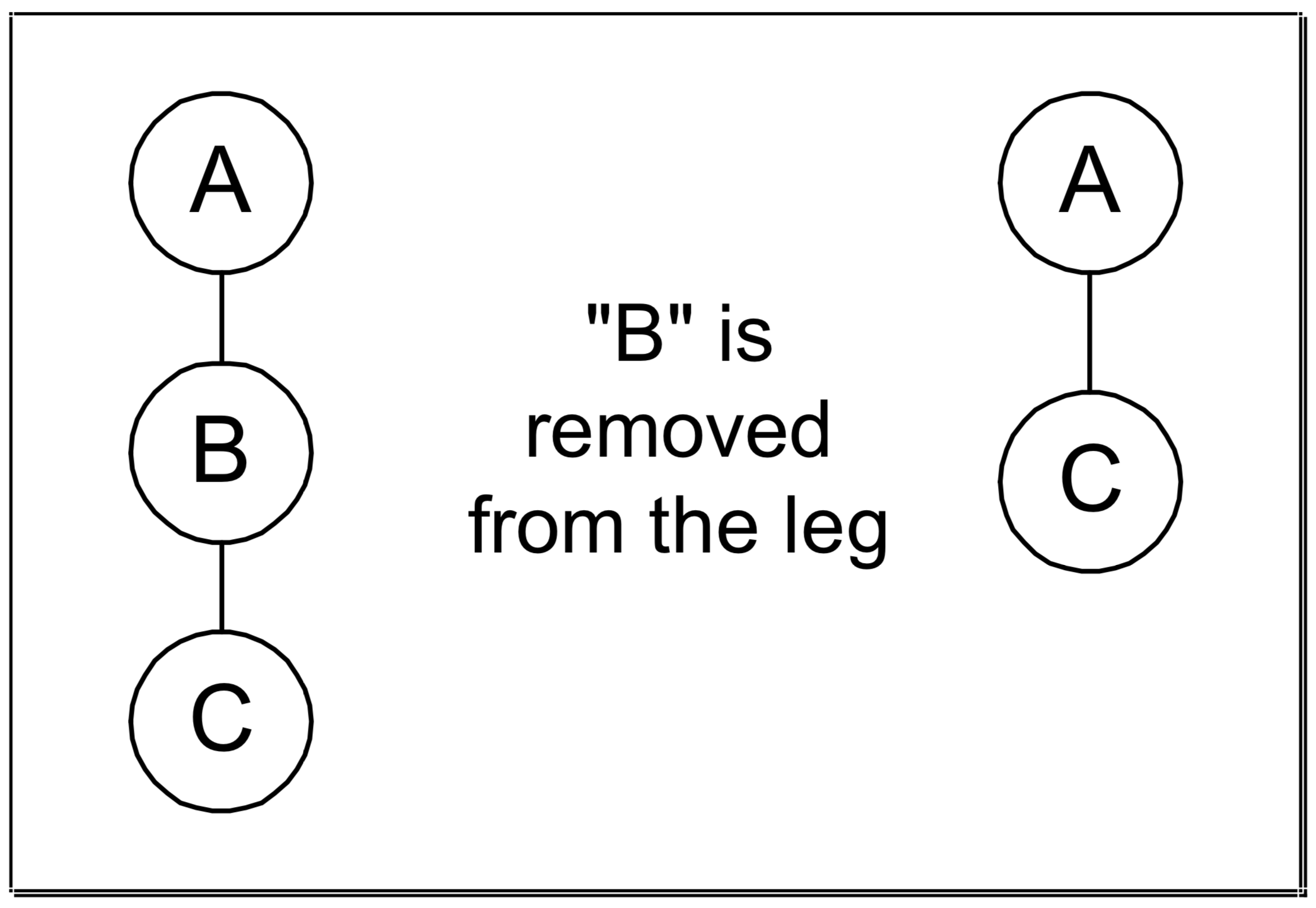
    Compression, therefore, relates to the effect of removing a distributor from a genealogy leg as in the following example:

    In this example, distributor B is removed from the genealogyresulting in distributor “C” being relinked to “A”. When “B” is removed, his entire first level is linked to their new sponsor, “A”, and all other downline distributors move up one level closer to “A”, compressing the downline by the one level vacated by “B”. This is called compression.

    Roll Up Defined

    If a commission payment cannot be paid to a distributor due to that distributor’s being inactive, unqualified or not eligible, the payment will “roll up” to the next qualified, active and eligible distributor upline. For example, a simple uni-level plan pays 10% to level 1 and 10% to level 2, but only if the distributor purchases $100 in the month.

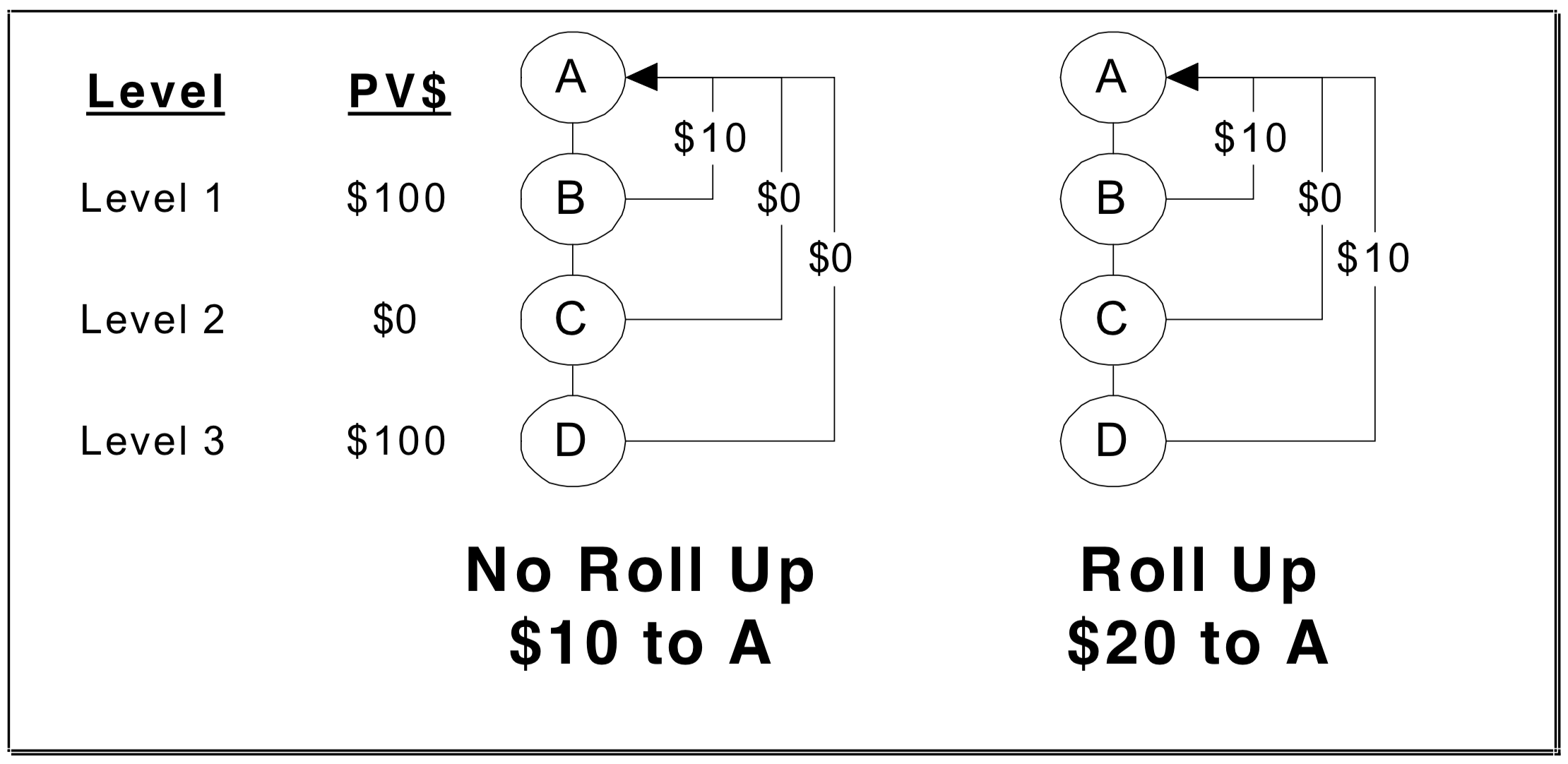
    The next example shows the effect Roll Up has on the commission of “A”.

    Without roll up, A receives a level 1 commission from B’s $100 purchase, no level 2 commission from “C” because C purchased nothing, and no commission from D because D is at level 3, beyond the reach of A (the plan only pays 2 levels).

    With Roll Up, A receives $10 from B, nothing from C (no purchase volume), and for this month only (next month C may be active, again), D is counted as 2nd level to A and A receives 10% on D’s $100 purchase. Conceptually, A receives commissions on two active levels with roll up and, therefore, reaches deeper, ignoring inactives, when counting levels.

    If “C” had purchased some product, but not enough to be active, then “C” would also be counted as 2ndlevel to “A”. In this case, both C and D would be counted as 2nd level to A, but only for the current month. Confused? Who said network marketing was simple?

    Why offer Roll Up?

    A golden rule of compensation plan design is to apply the incentive dollars toward the behavior that is desired (see “Are You Wasting Your Hard-Earned Commission Dollars?” Jenkon Newsletter). What behavior can roll up buy?

    To help sales leaders work deeply in their downline

    Sales leaders often find a one or more distributors many levels below them who need their help and attention because they cannot get it from their immediate upline. The sales leader is forced to work around the inactive or uncooperative manager(s) directly with the needful distributors. Would a sales leader spend their valuable time with these needful distributors, however, if he or she felt there was little potential reward? The deeper a group is, the less the potential reward for the upline sales leader because when the group catches fire, they will build below themselves even deeper and eventually out of reach of the salesleader’s commission check. Hence, sales leaders soon learn that without roll up, they need to ignore the deep distributors needing help and focus on the closer ones. With roll up, however, the inactive sponsors in between are ignored, so the sales leader can expect to reap the benefits of their efforts on a long term basis – depth is determined only by those who are active. Roll up, therefore, entices sales leaders to work deep because it offers them a return on their time.

    To entice sales leaders to move up the ranks by reaching deeper

    The deeper a person can reach for commissions, the larger their check will be (assuming they have a large downline). Sales leaders know that the largest earnings come from the volume at their deepest reach because there are more producers there – the deeper you go, the more people in the downline, level by level. Roll up can be used as a significant enticement for ambitious sales leaders who want to earn from yet deeper ranks of distributors in their organizations. For example, if a plan provides roll up to only the top three ranks of sales leaders, then lesser sales leaders will be striving aggressively to reach those top three positions because their commission checks will be substantially larger from the existing volume being generated. It would be like getting a huge raise!

    Mistakes to avoid

    Mistake #1: Offering roll up to most distributors

    Many plans I have seen offer roll up to most distributors as if it would turn on a huge amount of additional performance across the board. This is not so. Roll up works most effectively with sales leaders who have large organizations. It offers little incentive for distributors with shallow organizations because they already earn commissions from them.

    Mistake #2: My competitors do it, so I should, too

    Don’t fall into the trap of doing it just because others do it. Do it because it’s right for you. Roll Up costs your competitors a lot of money which you, instead, could put into other parts of your plan and get higher returns (desirable distributor behavior).

    Mistake #3: Giving roll up to non producers

    Understanding what behavior is bought with roll up, it becomes apparent that it should focus on active, qualified, performing sales leaders. Giving roll up to less performing distributors should be considered a waste of precious incentive dollars.

    Mistake #4: Not budgeting for roll up

    Roll up is expensive because it almost always pays out to the maximum limit of the plan. Without roll up, the company retains breakage to a much larger degree. Plans with roll up should expect to pay out close to their theoretical maximum.

    Conclusion

    Roll up can be a tremendous incentive for your active sales leaders who have large downlines. If you are giving away roll up commissions to nonproducers, to the less active, or to those with shallow downlines, consider making some changes in your plan in the future.

  • The 10 Most Common Mistakes in Direct Selling – Part 6

    #10: Growing Too Fast

    While most businesses would give their right arms to grow at exponential rates, direct selling has a track record of just that. Unfortunately, this kind of growth has often been a major cause of the demise of many otherwise successful ventures. Success is wonderful, but it can bury you.

    New businesses have new staff, new computer systems, new facilities, and are short on the experience to handle business efficiently. An office can only handle a certain volume of business. What if that volume is exceeded? Something must give. What if they run out of product for several weeks? Growth can be very expensive.

    While growing, cash seems to be unlimited. Some growing companies go on a spending spree throwing money at their problems. This too, is a false security, for as surely as the growth came, it will level out, and eventually go downward for periods of time. It may be far better to limit growth temporarily, than to succumb to its crushing demands.

    How can a direct selling company control its growth?

    If you think your growth will outpace your capacity to sustain it, then consider the following options:

    • Start locally by not accepting distributor applications from everywhere until you are ready. Distributors who seek to join from unopened regions are simply given a courteous thank you letter. Let them know how much you want to have them join, but that the opportunity isn’t available yet in their area. Notify them when they can join.
    • Don’t sponsor road trips by corporate or field promoters. Take advantage of the less expensive local opportunities, first. Meetings can be held locally every night of the week for the cost of one meeting on the road.
    • Don’t recruit professional direct selling promoters or big hitters. If they want to join, then they must join as any other distributor. Don’t, however, go out of your way to recruit them.

    By controlling growth, a business plan can become a real guide to making the business profitable. Use the plan to make success become a reality and don’t be too anxious to build your walls before you have built a solid foundation.

    Conclusion

    Direct selling offers incredible opportunities but also has a vast assortment of pitfalls and traps. Life is too short to learn every lesson by ourselves. We are far wiser to observe others, and let their experiences teach us a better way. By recognizing these common but sometimes fatal mistakes, your potential for success will improve dramatically. Those that have money to burn can ignore these rules. Those that must be careful and have budgets to contend with should give heed to these 10 mistakes most often made by other direct selling companies. It may save your business and help you realize your dreams of success.